
 By
ByDeepSeek V4-Flash beats its own 1.6T flagship on agents
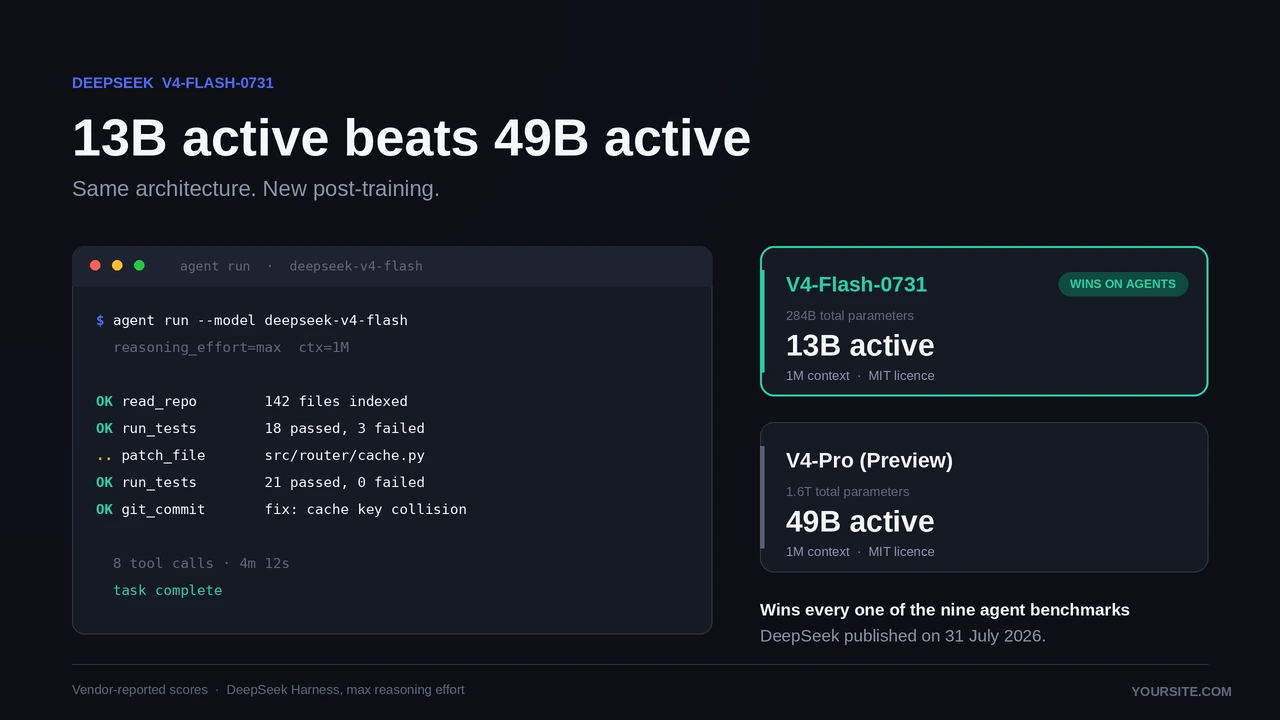
DeepSeek pushed V4-Flash out of preview and into public beta on July 31. The model string stayed the same. So did the architecture, the parameter count, and the price. The only thing the company redid was post-training, and the result is strange enough to be worth sitting with: a model that activates 13 billion parameters per token now outscores DeepSeek’s own 1.6-trillion-parameter flagship on all nine agent benchmarks the company published.
The clearest example is DeepSWE, a repository-level coding benchmark. The April preview build of Flash scored 7.3. The July build scores 54.4.
The cheap tier stopped being the fallback
DeepSeek shipped the V4 family on April 24 as a matched pair of preview models, both MIT-licensed, both with a million-token default context. V4-Pro carried 1.6T total parameters with 49B active. V4-Flash carried 284B total with 13B active. The division of labor was obvious. Pro handled the hard reasoning, Flash handled volume. [link to our April V4 preview coverage]
That hierarchy is what the 0731 build inverts. DeepSeek’s model card is unusually blunt about the mechanism, stating that the new checkpoint has the same structure and size as the preview and calling it broadly competitive with “the strongest proprietary models available.” No new weights architecture, no scaling. Just a rebuilt post-training pass aimed at tool use, planning, and error recovery.
Two other changes ship alongside it, and they tell you more about intent than the benchmark table does. The official Flash speaks the OpenAI Responses API format natively and carries a documented Codex configuration, so you can point a Codex-style agent at DeepSeek without writing a translation shim. And the checkpoint arrives with DSpark, a speculative decoding module attached to the same weights rather than served as a separate draft model.
Put those together and the positioning is hard to miss. DeepSeek wants Flash to be the default model behind coding agents, not the budget option you fall back to.
There’s a broader claim buried in here that deserves more attention than the leaderboard. If a 13B-active model can be trained into beating a 49B-active one on long-horizon agent tasks without touching the architecture, then what limits agent performance isn’t raw capacity. It’s whether the model has been taught to plan, check its own work, and recover from a failed tool call. Those are learned behaviors, and they’re cheaper to buy than parameters.
The scores, and who actually ran them

Here’s the part most coverage skipped past. Every headline number in that table was produced by DeepSeek, on DeepSeek’s own harness, which DeepSeek has not released.
The company evaluated the code-agent tasks using what it calls DeepSeek Harness in minimal mode, at max reasoning effort, with temperature at 1.0 and top_p at 0.95. Agent scores are notoriously sensitive to scaffolding.
Change the harness and the same model can swing ten points in either direction. Until that tooling is public, nobody outside the company can reproduce a single one of these figures.
| Benchmark | Flash-0731 | Flash Preview | V4-Pro Preview | Opus 4.8 |
|---|---|---|---|---|
| Terminal Bench 2.1 | 82.7 | 61.8 | 72.1 | 85.0 |
| DeepSWE | 54.4 | 7.3 | 12.8 | 58.0 |
| Toolathlon-Verified | 70.3 | 49.7 | 55.9 | 76.2 |
| Agents’ Last Exam | 25.2 | 15.8 | 16.5 | 25.7 |
Read that last column carefully. On DeepSeek’s own table, using DeepSeek’s own harness, Anthropic’s Opus 4.8 still leads every row. The gap on Agents’ Last Exam is half a point, which is genuinely close. The gap on NL2Repo, which isn’t in the table above, is 54.2 against 69.7, which isn’t close at all.
“Agentic king” is a stretch. “Suddenly competitive with models costing forty times more” is accurate and more interesting.
There’s also a credibility precedent worth knowing. TechTimes flagged an independently run, contamination-free DeepSWE test from yage.ai in which V4-Pro managed 8% pass@1 while GPT-5.5 hit 70%. That’s the same benchmark family where Flash now claims 54.4 under vendor conditions. It doesn’t mean the new number is wrong. It means the number that survives an outside re-run is the one that counts.
Artificial Analysis gives us the one semi-independent read available right now. Its Intelligence Index put V4-Flash-0731 at 50, a ten-point climb over the April build and six points clear of V4-Pro.
Useful, but that index measures general capability across nine tests, not the agent suite DeepSeek is advertising. On the same index, Moonshot’s Kimi K3 sits at 57, and Claude Opus 5, Fable 5 and GPT-5.6 all clear Flash by at least nine points. Artificial Analysis also ran Terminal-Bench 2.1 without DeepSeek’s harness and landed a few points below the official 82.7.
The crown nobody disputes is the price one
If there’s a title V4-Flash unambiguously holds, it’s cost per completed task.
Artificial Analysis measures models by what a full benchmark run costs rather than by sticker price, because the two diverge badly when a cheap model needs twenty steps to get where an expensive one gets in three.
By that measure, Reuters reported V4-Flash at roughly 3 cents per benchmark run. Kimi K3 came in at 86 cents. GPT-5.6 Sol at $1.86. Claude Fable 5 at $3.15.
Published rates are $0.14 per million input tokens on a cache miss, $0.28 per million output, and $0.0028 on a cache hit. No price change accompanied the July upgrade.
The number I’d watch more closely is concurrency. Flash supports 2,500 simultaneous requests against Pro’s 500. If you’re running an agent fleet, that five-times headroom decides more about throughput than any benchmark on the page.
Developers appear to have already voted. Flash topped OpenRouter’s weekly token consumption at 7.1 trillion tokens, with Chinese models taking nine of the global top ten slots as total weekly usage crossed 56.
8 trillion. DeepSeek also closed its first outside funding round, reported by The Next Web at north of $7 billion, which suggests the undercutting isn’t a promotional phase.
What developers are actually saying
The reaction since July 31 has been loud and mostly one-note: this is the moment open weights caught up on agents. The recurring line among developers posting side-by-side comparisons is some version of “what are the closed labs charging for, the intelligence or the brand name?” Plenty are posting receipts, and the receipts are small.
Job totals in cents rather than dollars. Agent runs that would have chewed through a Claude usage limit. Orchestration setups where Flash handles the planning layer for a fleet of subagents.
Two caveats keep surfacing from the more careful accounts. The first is a reminder that this is Flash, not Pro, and Pro’s official release is still pending.
The second is sharper: the published scores assume max reasoning effort, which is the setting that makes a benchmark look great and a production invoice look awful. One post called it benchmaxing.
That criticism isn’t speculation about DeepSeek’s methodology. It’s sitting in DeepSeek’s own testing notes. Max effort, temperature 1.0, top_p 0.95.
What it costs you in other ways

Flash is verbose, and that’s not a small footnote when reasoning tokens bill at the output rate. Generating Artificial Analysis’s index took it 210 million output tokens against a median of about 100 million for comparable open-weight models. A cheap per-token rate multiplied by twice the tokens is a different arithmetic than the headline suggests.
It’s text-only, with no image input. DeepSeek has announced a 2x peak-hours surcharge for Beijing working hours that hasn’t taken effect yet. And self-hosting isn’t casual: roughly 110GB of memory at 3-bit quantization, or a four-GPU GB300 node for full precision.
One thing has resolved since launch week, though. The open-weight status was an open question on July 31 because the 0731 weights weren’t up yet. They’re on Hugging Face now under MIT, ungated, with more than 236,000 downloads logged in the past month.
What to watch next
Three things will settle whether this holds. The first is DeepSeek Harness itself, promised but not shipped, and the moment it lands every score above becomes checkable. The second is V4-Pro’s official release, which DeepSeek has only described as coming soon, with Responses API and Codex support for Pro documented for early August.
Chinese tech outlet 智能纪元AGI reported a possible August 10 to 20 window, which DeepSeek has not confirmed.
The third is whether Flash keeps its OpenRouter lead now that Alibaba has announced Qwen3.8-Max. Cheap defaults are sticky, but they’re only sticky until something cheaper works better on your own evals. Which is the only benchmark that should decide your routing table anyway.


