
 By
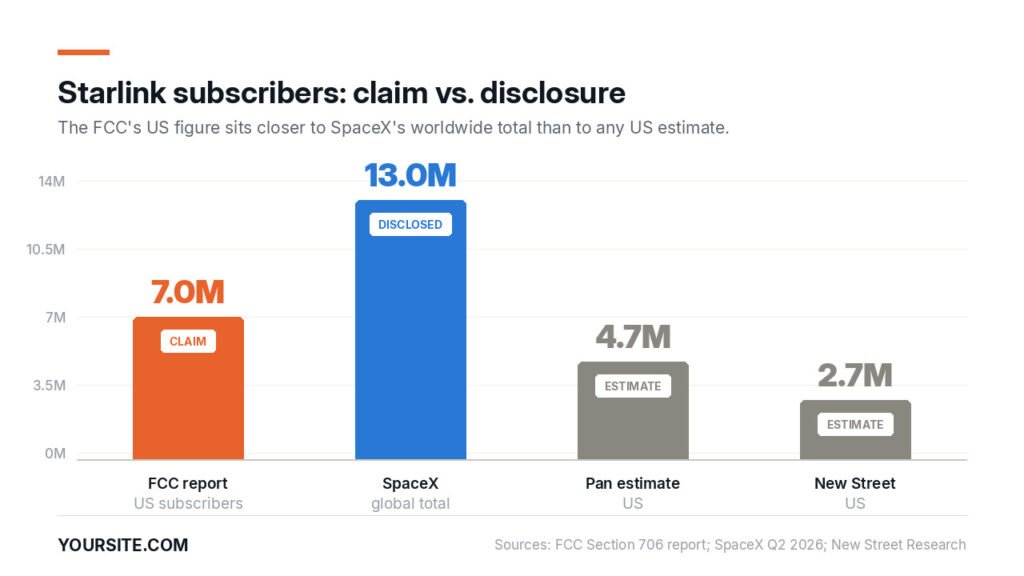
BySpaceX’s own most recent public figure for the entire planet is 13 million.
Both of those can’t be true in the way the report frames them. PCMag flagged the discrepancy over the weekend, and once you look at the sentence the FCC actually wrote, it reads less like a revelation about Starlink’s US growth and more like two facts that got welded together during editing.
The mistake is still worth understanding, because of where the number sits and what the report around it is being used to argue.
What the report actually says
The document is the FCC’s Section 706 report, the assessment Congress requires each year on whether broadband is reaching Americans in a reasonable and timely fashion. This year’s runs 182 pages and concludes that it is. [link to prior coverage]
In the satellite passage, the report credits Starlink with launching more than 2,300 satellites between mid-2024 and mid-2025 and deploying over 7,800 in total, calling it “a worldwide network already with over 7 million American subscribers.”
Read that clause twice. It describes the network as worldwide and the subscribers as American inside the same phrase.
The satellite count is the second tell. Starlink passed 7,800 satellites around June 2025. The constellation now sits near 11,000, a figure Elon Musk repeated at a company all-hands earlier this month. The whole passage is describing the middle of last year.
And the citation propping it up, per PCMag’s reading of the report, is a SpaceX update from July 2025. That update reported more than 6 million active customers globally and more than 2 million of them in the US.
Why 7 million doesn’t work as a US number
Start with the arithmetic, which is the fastest way through this.
SpaceX reported 12 million Starlink subscribers worldwide at the close of Q2 2026, disclosed August 4 in its first earnings release as a public company.
A week later, the company posted an all-hands video in which Musk put consumer subscribers above 13 million, alongside 22 million monthly Starlink Mobile users.
For the FCC’s figure to hold, better than half of every Starlink dish on Earth would need to be pointed at an American roof. Starlink sells in roughly 170 markets. Its average revenue per user has fallen from $85 to $66 over the past year precisely because the growth is coming from lower-priced international plans, which is the opposite of a US-concentrated subscriber base.
Independent estimates land nowhere near 7 million either. New Street Research put Starlink at about 2.7 million US subscribers earlier this year, enough to make it a top-ten American ISP, with more than 85% of those customers in rural areas.
Jianping Pan, a University of Victoria professor who studies satellite internet systems, told PCMag he believes the commission simply “mixed up the context” and that 7 million was roughly the global base around mid-2025. Pan’s own tracking, based on public IPv6 addresses tied to Starlink routers, puts the US count closer to 4.7 million.
That’s a wide spread between 2.7 and 4.7 million, and the gap itself is interesting. Router-level IPv6 tracking will pick up hardware that a subscriber count wouldn’t, including roaming units, RV kits and dishes sitting dormant. But note what happens even at the top of the independent range. The most generous outside estimate is still short of 7 million by more than two million users.
The explanations that could close part of the gap
There are legitimate reasons the real US number might run higher than SpaceX’s last official disclosure.
Enterprise, maritime and aviation accounts have grown fast, and SpaceX’s enterprise and government revenue more than doubled year over year in Q2. Tim Belfall, a director at UK installer Westend WiFi, suggested to PCMag that more American businesses are buying Starlink as a backup connection rather than a primary one.
Some of those dishes sit on the $10-per-month Standby Mode plan, which complicates any definition of “active subscriber.”
Then there’s Starlink Mobile, the satellite-to-phone service sold in the US through T-Mobile as T-Satellite. If the FCC folded direct-to-cell users into the same bucket as dish customers, the number gets closer to plausible. Musk’s 22 million monthly mobile figure almost certainly counts carrier partnership users rather than people buying a standalone product.
But none of that is what “subscribers” means in a broadband deployment report, and the FCC doesn’t explain which definition it used. Neither the commission nor SpaceX responded to PCMag’s request for comment.
Why a subscriber number matters in this particular report
Here’s the part that makes this more than a typo hunt.
This year’s Section 706 report is the one that folds satellite into the availability picture in a serious way. It claims 99.7% of Americans can reach satellite broadband at 100/20 Mbps, and states that once satellite is counted, rural deployment approaches universal coverage.
The terrestrial numbers underneath are more modest: 96.9% of Americans had access to fixed terrestrial broadband at 100/20 Mbps as of June 2025, with roughly 10.5 million people still without it, more than 9 million of them rural.
Commissioner Anna Gomez concurred rather than fully supporting the report, and singled out that satellite availability claim as misleading. Her objection is about usability, not coverage.
A dish that can technically be installed anywhere still needs clear sky, and Ookla’s data found only 44.7% of US Starlink customers actually hit 100/20 Mbps in Q4 2025. That was a steep improvement from 17.4% a year earlier, and it’s still under half.
Now consider the structural oddity. The commission narrowed this year’s report to a deployment-only reading of the statute, dropping the affordability and adoption analysis the 2024 edition included.
A subscriber count is an adoption metric. It appears in a report that spent its opening pages explaining why adoption isn’t the question anymore, and it appears inflated in a direction that flatters the technology the report leans on hardest.
The stakes aren’t theoretical. NTIA has asked states to strip out as many as half the locations they awarded to satellite providers under the BEAD program, after new FCC mapping showed many were already served or weren’t serviceable structures.
Analysis from New York Law School’s ACLP estimated roughly 312,000 LEO-awarded locations could fall out, cutting about $354 million.
Starlink has more at stake there than anyone. It holds 476,000 BEAD locations, more than any other provider, backed by $738.8 million in grants. Last week NTIA told states they can’t unilaterally rewrite contracts they’ve already signed.
Federal broadband policy is being redrawn around how much of the rural gap satellite can absorb. Numbers describing that satellite footprint deserve to be right.


