
 By
ByiPhone 18 Pro Max’s 5,567mAh battery leak, explained
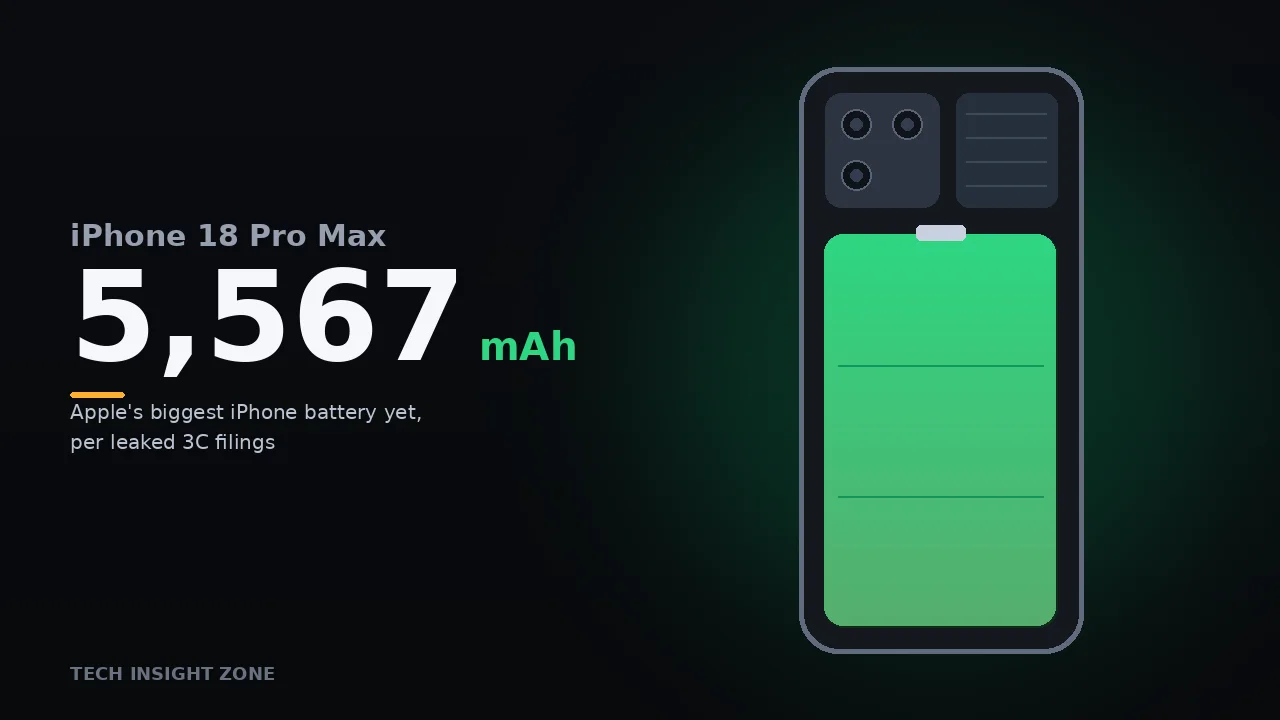
Apple is on track to ship the biggest battery it has ever put in an iPhone, and for once the evidence isn’t a screenshot from an anonymous account that gets deleted an hour later. New entries in China’s 3C certification database, spotted by Weibo leaker Digital Chat Station and reported by MacRumors on July 6, put the iPhone 18 Pro Max at 5,567mAh in its US form and 5,391mAh everywhere else. The iPhone 17 Pro Max shipped with 5,088mAh and 4,823mAh. So we’re looking at a gain of roughly 480mAh to 570mAh, depending on which version you buy.
That’s the headline number, and it’s the least interesting thing in the filing.
Look one row up. The iPhone 18 Pro goes from 4,252mAh to 4,288mAh in the US. That’s 36 milliamp-hours, which is a rounding error you’d struggle to detect with a stopwatch. Apple isn’t giving the Pro line a bigger battery this year. It’s giving the Pro Max one, and letting the smaller phone sit still.
Why these filings carry more weight than the usual leak
Apple has never published battery capacities. It quotes video playback hours instead, and the actual cell sizes only get confirmed when someone pries the phone open after launch. That vacuum is why Chinese regulatory paperwork has become the best pre-launch source available, and last year the same database called the iPhone 17 Pro’s capacities correctly ahead of the event, as Cult of Mac noted.
The detail in the current listings supports that. MacRumors reported battery model numbers S2232 and S2233 for the Pro, plus 2235L/2235 and 2236L/2236 for the Pro Max, alongside rated energy of up to 21.751Wh, a 4.520V charge limit, and certification valid into 2031. That’s not the shape of a fabricated rumor.
Two caveats, though, and both are real. The filings don’t actually name the iPhone 18 Pro or Pro Max, so the mapping is inference rather than fact. And AppleInsider pointed out something the cheerier write-ups skipped: Digital Chat Station’s track record is uneven, and this same tipster claimed back in February that the Pro Max would land near 5,000mAh in China and somewhere around 5,100 to 5,200mAh in the US. Those earlier figures implied a rise of about 2%. The new ones imply nearly 10%. Same source, very different story, five months apart.
There’s also a competing set of numbers still floating around. In early July, GSMArena picked up a since-deleted post from the leaker Fire Universe claiming 5,425mAh and 5,235mAh, and Tom’s Guide and others ran with it. Macworld openly questioned the sourcing on that one. Both sets can’t be right. The 3C figures are the higher pair and rest on regulatory documents rather than a vanished tweet, which is why they’ve become the consensus, but “more credible” isn’t the same as “confirmed.”
US buyers get more, and the reason is a hole in the side of the phone
The regional split comes down to the SIM tray. American iPhones have been eSIM-only since the iPhone 14, which frees a small pocket of internal volume, and Apple fills it with battery. Everywhere a physical tray survives, including China, the cell gets shorter.
Here’s a wrinkle nobody seems to have flagged. Last year the gap between the two versions was 265mAh. This year, by these figures, it’s 176mAh. The international model is gaining more capacity than the US one (568mAh against 479mAh), so the tray penalty is shrinking. Notebookcheck spotted the same pattern. If the numbers hold, Apple found room somewhere that has nothing to do with the SIM slot.
The split between Pro and Pro Max is the real news

For years, buying the smaller Pro meant accepting a shorter day for a phone that fit your hand better. That was a fair trade because both models moved forward together. This year, only one of them does.
A 479mAh gain on the Pro Max against 36mAh on the Pro isn’t an accident of internal packaging. It’s a decision. Apple is turning battery life into the reason you buy the big one, in a year when the Pro Max is no longer even the flagship. That title is widely expected to go to the foldable arriving at the same September event, with the standard iPhone 18 and 18e held back to spring 2027.
So the Pro Max needs a pitch. “It lasts longest” is that pitch.
“Biggest ever” is an Apple record, not a phone record

The framing to be careful with here is the one in every headline, including this one. Biggest battery Apple has ever shipped, yes. Big battery, not really.
Samsung’s Galaxy S26 Ultra sits around 5,000mAh, so 5,567mAh clears it, and that’s a first for the iPhone line. Then look at Xiaomi, Oppo, and OnePlus, where flagships have been shipping past 7,000mAh for a while now. Measured against those, Apple’s record-setting cell lands somewhere in the middle of the pack.
That gap isn’t the embarrassment it looks like, because capacity has never been how Apple competed. Tight control over silicon, display, and software has kept iPhones near the top of real endurance charts while carrying visibly smaller cells than the competition. The mAh figure was always the wrong scoreboard.
Which is what makes this year odd. Apple is now moving the number it spent a decade telling everyone not to look at, and accepting weight to do it. That reads less like a strategy shift than an admission that on-device AI in iOS 27 needs headroom that efficiency alone won’t cover.
What 2nm actually buys, and what it doesn’t
Nearly every write-up pairs the battery with the A20 Pro and TSMC’s 2nm process, then cites a figure of around 30% better efficiency. That number is being badly misused.
TSMC’s published N2 specification says the node delivers a 10% to 15% performance gain at the same power, or a 25% to 30% power reduction at the same performance, measured against N3E. Those are transistor-level figures against one specific older baseline, and they’re an either/or. Chip designers rarely take the full power saving, because they usually spend part of the budget on speed instead. Apple always spends some of it on speed.
More to the point, the chip isn’t what’s draining your phone. A 6.9-inch OLED running bright outdoors will eat more than the SoC does, and the modem, radios, and camera pipeline all take their cut. “30% more efficient silicon” does not mean 30% more screen time. It never has.
None of which makes the pairing meaningless. A bigger cell plus a genuinely more efficient chip plus the in-house C2 modem should compound into a real improvement. Just not the one the number implies.
The cost is seven grams

Physics gets a vote. Ice Universe told followers on July 9 that the iPhone 18 Pro Max will land near 9mm thick and around 240 grams, against 8.75mm and 233 grams for the current model. Call it a quarter millimetre and seven grams.
The battery is most of that, but not all of it. Apple is also rumored to be moving to a stainless steel vapor chamber, and steel is denser than the copper it would replace. Whether you’d notice seven grams in a pocket is doubtful. What matters is the direction. Apple spent the last two years chasing thinness hard enough to build the iPhone Air around it, and the Pro Max is now walking that back to buy endurance.
One correction worth making, since it’s spreading: this would not be the heaviest iPhone ever. The iPhone 14 Pro Max also weighed 240 grams. At best it ties.
What to watch next
The September event will confirm none of this directly, because Apple won’t read out a milliamp-hour figure from the stage. Watch the video playback hours in the tech specs instead, then wait for the first teardowns to check the cells against these filings. That’s the moment the 3C database either earns its reputation or loses it.
The sharper question arrives sooner. If you’re weighing an upgrade and you want the battery, the filings say there’s exactly one phone in the lineup offering it this year, and the price of admission is 6.9 inches and 240 grams.


