 By
ByGhost AI: Inside the Stealth Interview Assistant Boom
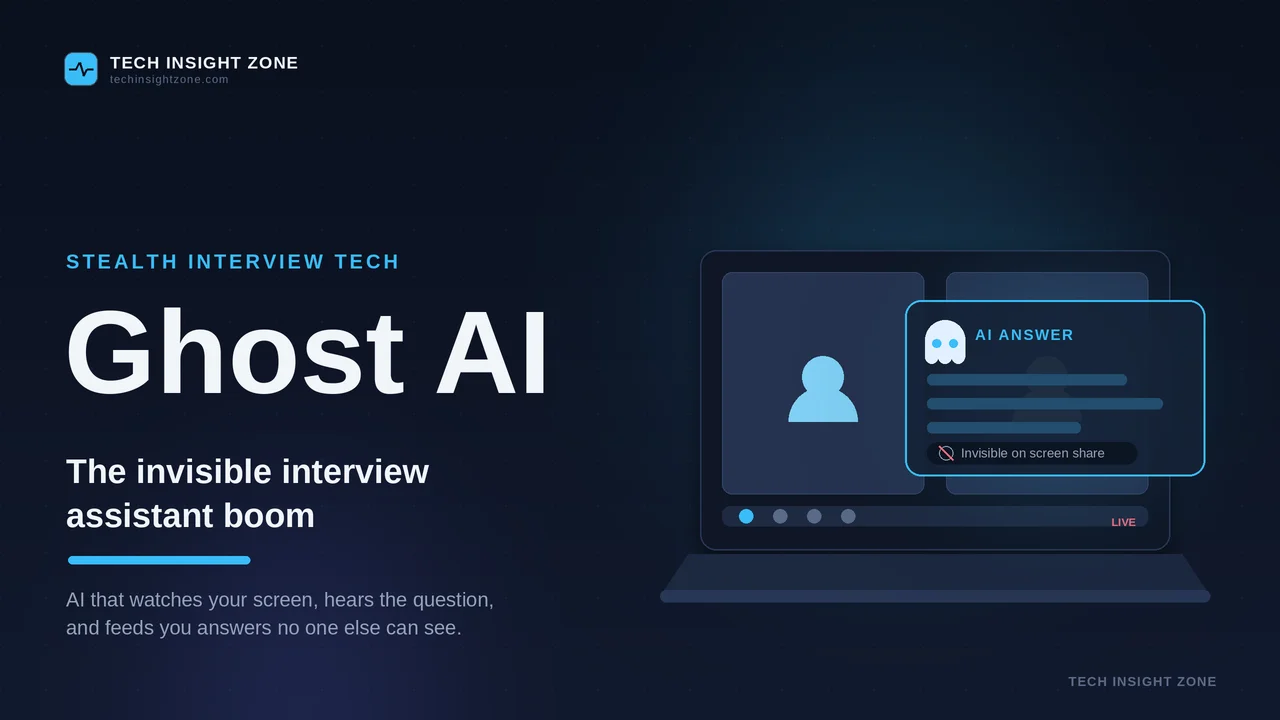
Search an app store for “ghost” and you’ll find a small industry that didn’t exist two years ago. GhostCoder, GhostInterview, GhostAssist, GhostDesk, GhostNote. They sell the same promise in slightly different wrapping: an AI that watches your screen, listens to your interviewer, and feeds you answers through an overlay the person on the other end of the video call can’t see.
GhostAssist markets itself as a one-time $16.99 purchase whose window is invisible to screen capture and stays local to your machine. LockedIn AI goes further, suggesting you alias its background process to something like “Ghost.exe” so it blends in inside Task Manager.
These tools have a nickname now, “Ghost AI,” and they’ve turned the remote job interview into one of the most contested surfaces in tech. The pitch is invisibility. The problem is that invisibility, by design, is aimed at deceiving the person doing the hiring.
The startup that made it a category
Most of this traces back to one founder. In March 2025, Columbia University suspended Chungin “Roy” Lee and co-founder Neel Shanmugam over a Chrome extension called Interview Coder, which fed AI-generated solutions to LeetCode problems during technical job interviews.
Lee had recorded himself using it on an Amazon interview, landed the offer, and posted about it. Amazon rescinded the offer, and Columbia placed him on academic probation before suspending him for a year.
Rather than wait it out, Lee and Shanmugam dropped out and rebuilt the tool as Cluely, which launched on April 20, 2025 under the tagline “Cheat on Everything” and drew 70,000 signups in its first week. The money followed the noise.
Cluely raised $5.3 million in seed funding from Abstract Ventures and Susa Ventures, then a $15 million Series A led by Andreessen Horowitz at roughly a $120 million valuation.
Here’s the part worth sitting with. The controversy wasn’t a side effect of the marketing. It was the marketing.
How the invisibility actually works

The reason these overlays work comes down to how they’re drawn on screen. Cluely, the most technically capable of the bunch, renders its overlay through low-level GPU hooks, DirectX on Windows and Metal on macOS, which means it doesn’t appear when you share your screen in Zoom, Google Meet, or Microsoft Teams. The people on your call see your code editor. They don’t see the floating panel on top of it.
The rest is a pipeline you can now buy off the shelf. The app reads your screen with OCR, captures system audio through speech-to-text, feeds both to a large language model, and surfaces an answer in a floating overlay while the call is still live. Question in, polished answer out, no visible tab-switching and no obvious glance away from the camera.
That’s the capability the whole “Ghost” cottage industry is selling. Cluely just did it loudest, and at $19.99 a month it undercut rivals like LockedIn and Final Round AI, which run closer to $55 to $70 and $149 a month respectively.
The field is already a race to the bottom
Here’s what complicates the “one controversial startup” framing. Ghost AI isn’t really a single product anymore. It’s a commodity. Search GitHub and you’ll find dozens of open-source Cluely clones with names like OpenCluely, Natively, and ShadeCoder, most offering the same core trick: an invisible overlay, screenshot OCR, real-time transcription, and bring-your-own API key, often for nothing.
That cuts two ways. It means the capability can’t be un-invented or bought out. Even if Cluely vanished tomorrow, the code to rebuild it is public. It also means that for all the noise, the actual chatter among candidates stays oddly quiet. Scan social platforms and the loudest voices are the toolmakers themselves, not a groundswell of users trading success stories.
This reads less like a viral movement and more like a crowded software niche selling to anxious job seekers, one $1-for-a-few-hours plan at a time.
The numbers behind the panic
This would be a curiosity if the tools weren’t working. They are.
CodeSignal, which analyzes technical assessments at scale, reported that cheating and fraud attempt rates more than doubled in 2025, from 16% in 2024 to 35%. A separate study by the AI interview platform Fabric, drawn from more than 19,000 interviews between mid-2025 and early 2026, put it higher: nearly 39% of all candidates triggered cheating-behavior markers, rising to 48% among technical candidates, and 61% of flagged candidates had already scored above the passing threshold. In other words, without a separate detection layer, most of them would have advanced.
The pattern underneath is telling. Fabric found that junior candidates with zero to five years of experience cheat at nearly double the rate of senior ones, which fits a brutally saturated entry-level market where applicants feel they need every edge to get a foot in the door.
Even AI labs aren’t immune. According to one recruiting firm’s account, Anthropic said in January that it had to rewrite its own technical interview questions because so many candidates were cheating with Claude.
Companies are dragging interviews back into the room

The response has been blunt. If you can’t trust the video call, take away the video call.
A Gartner survey found 72.4% of recruiting leaders now conduct interviews in person to combat fraud, and Google, Cisco, and McKinsey have all reinstated in-person rounds for some candidates.
The swing has been fast. Per the Greenhouse 2026 AI Hiring Report, 61% of companies now run software to detect AI use during interviews, 39% are doing more interviews in person, and in-person interview requests at major recruitment firms jumped from 5% in 2024 to 30% in 2025.
A detection industry has grown up alongside the cheating one. Validia built anti-cheating software called Truely aimed squarely at spotting tools like Cluely. Talview secured a U.S. patent for an agentic proctoring system called Alvy that claims to flag eight times more suspicious activity than passive monitoring, with deepfake detection accuracy around 95%.
And the invisibility isn’t absolute. Vendors including Talview and TestGorilla have added detection patterns aimed at the Cluely-style overlay category, and even reviewers who like these tools concede that none can honestly promise it stays hidden in 2026. It’s an arms race where both sides ship new versions monthly.
Is it even cheating? That’s the uncomfortable part

But the honest version is messier.
Employers are hardly AI purists. Roughly 96% of hiring professionals now use AI somewhere in recruiting, and Meta now allows candidates to use AI in one of its coding rounds, with AI code verification built into the evaluation.
When a company screens you with AI, then bans you from touching it, plenty of cFlagged or attempted AI-assisted fraud among technical candidates more than doubled in a year. Sources: CodeSignal; Fabric analysis of 19,368 interviews.andidates read that as hypocrisy rather than principle. Lee built Cluely’s entire pitch on that tension, comparing the tool to the calculator and spellcheck, both once dismissed as cheating.
There’s a trust cost either way. About 66% of U.S. adults say they wouldn’t apply for a job that uses AI in hiring decisions, so both sides of the table now eye each other with suspicion. And the tools carry real risk for the people using them.
Cluely’s 2025 breach exposed the personal data, transcripts, and screenshots of more than 83,000 users, reportedly after an admin password was left sitting in a public GitHub repository. Security researcher Jack Cable later flagged a separate flaw that let any website opened through the app silently capture screenshots. When he reported it, the company reportedly responded with legal takedown notices rather than a fix.
Where this goes next
Cluely itself has already backed away from the word that built it. By late 2025 it had stripped the cheating language from its site and repositioned as a conventional AI meeting assistant competing with tools like Otter.ai. In March 2026, Lee also admitted he had lied about the company’s revenue, walking back an earlier $7 million figure. The brand that sold deception got caught being deceptive about itself.
The in-person comeback is a patch, not a fix. It doesn’t scale to high-volume hiring, and it quietly undoes years of remote-work access. The deeper question is what an interview should even measure when AI is a normal part of the job you’re interviewing for.
Watch two things over the next year: whether detection tools can tell a cheater from a nervous non-native speaker without punishing the second group, and whether Gartner’s projection that one in four job applicants will be fake by 2028 forces identity verification to become a standard step. The ghosts aren’t going away. The room they haunt is just getting smaller.


