
 By
ByAI agents and the future of work: hype vs. reality
On July 14, on JPMorgan’s second-quarter earnings call, Jamie Dimon said the bank had already cut headcount by 30% to 40% in some specific areas thanks to AI. Then he did the thing the tech feeds mostly skipped over. He warned that anyone expecting AI to slash the bank’s costs and send margins soaring would be waiting a long time. It won’t happen anytime soon, he said.
That gap, between what AI is doing to work and what people claim it’s about to do, is the real story of 2026.
The pitch you keep seeing
Scroll any tech timeline right now and you hit the same line. The future of work is managing AI agents. Not using a chatbot, but running a whole team of them. The pitch usually arrives with a Jensen Huang quote attached and a number that keeps climbing.
Huang did say something close to it. At Nvidia’s GTC conference in March, according to Fortune, he pictured Nvidia a decade from now with roughly 75,000 human employees working alongside 7.5 million AI agents. A hundred agents for every person. On CNBC after earnings, he put it more bluntly: 42,000 “biological employees” and hundreds of thousands of digital ones.
It’s a great image. It’s also a forecast about the 2030s, delivered by the man selling the chips that make agents run. Both of those are worth holding in mind at once. The people with the boldest visions of an agent-run workplace are, more often than not, the people selling agents or the silicon underneath them.
What’s actually happening in 2026
The grounded numbers are smaller than the tweets, and more interesting for it.
What the timeline promises vs. what the numbers show. Sources: Gartner, McKinsey, Fortune.
Gartner expects task-specific AI agents to be built into 40% of enterprise apps by the end of this year, up from under 5% in 2025. It also predicts that by 2028, agentic AI will handle at least 15% of day-to-day work decisions and show up in a third of enterprise software. That’s real growth. It is not “100 agents per engineer” growth.
A November 2025 McKinsey survey found 62% of organizations were at least experimenting with agents. Experimenting is the operative word. Most of those companies hadn’t started scaling anything.
The clearest real-world number comes from JPMorgan, and it rewards a close read. Dimon’s 30% to 40% cut applied to certain specific teams, not the whole bank. More than 230,000 of its staff already use its in-house LLM tools for drafting, compliance and support work, and its contract-reading system has chewed through legal review that used to eat hundreds of thousands of hours.
Yet Dimon said most of the affected workers were offered other jobs inside the firm. This is reorganization, redeployment and reskilling. It is not a switch being flipped from human to machine.
The part the hype threads leave out
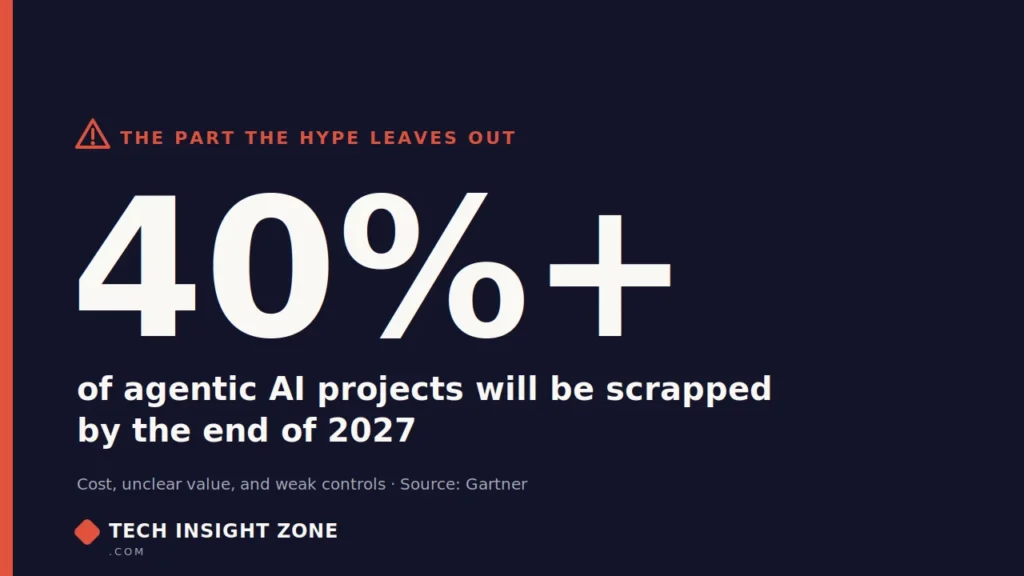
Here’s the figure you won’t find in a bookmark-this roadmap thread. Gartner predicts that more than 40% of agentic AI projects will be scrapped by the end of 2027, done in by rising costs, fuzzy business value, or weak risk controls.
Gartner expects 40%+ of agent projects to be cancelled by the end of 2027.
Why so many failures? Because bolting an agent onto a legacy system is hard, and doing it well usually means rebuilding the workflow around the agent rather than dropping it into the old one. That’s expensive and slow, and it’s the opposite of the plug-and-play story.
There’s also a naming problem, and Gartner has a term for it: “agent washing.” Vendors slap the word “agent” on tools that are really old chatbots, rule-based scripts, or robotic process automation with a fresh coat of paint. By Gartner’s count, only a small fraction of the thousands of “agentic” products on the market actually do what the label promises.
So when a post claims multi-agent workflows “exploded 327%,” ask what’s being counted. A lot of that is marketing catching up to a buzzword, not autonomous systems running a company.
What workers actually want, and this is the real find
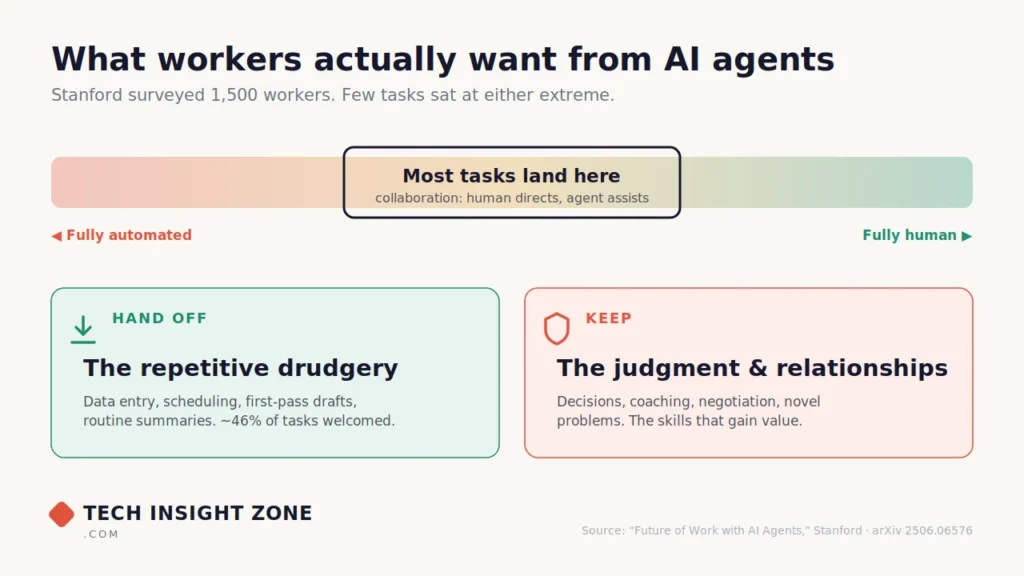
The most useful piece of research on any of this got a fraction of the attention of a single Huang soundbite. A Stanford team that includes the economist Erik Brynjolfsson surveyed 1,500 workers across 104 occupations and 844 tasks, then built a database out of it called WORKBank. The paper is titled “Future of Work with AI Agents.”
Its central finding cuts against the replace-everything story. Workers welcomed AI on plenty of tasks, roughly 46% of them, but almost entirely for the drudgery. The repetitive, low-value work they’d gladly hand off. What they resisted was AI taking over the parts of the job that need judgment, relationships and a human in the loop.
What 1,500 workers told Stanford: automate the drudgery, keep the judgment. Source: arXiv 2506.06576.
The researchers built a “Human Agency Scale” to measure exactly this. Very few tasks landed at either extreme, fully automated or fully human. Most sat in the middle, in collaboration territory, where a person directs and the tool assists.
There’s a mismatch buried in the numbers, too. On a lot of tasks, workers wanted to keep more control than the AI experts thought was technically necessary. That gap matters more than it looks. It suggests the ceiling on agent adoption won’t only be what the models can do, but what the people using them are willing to hand over.
Push past that line and you get the resistance the study also picked up, with a real share of workers flatly negative about automation creeping into their daily work.
The second finding is the one to sit with. As agents absorb the information-processing work, the skills that gain value are the human ones. Communication, coordination, teaching, judgment. Not prompt-wrangling. The Stanford data points to a workplace where interpersonal skill becomes the scarce resource, not the ability to herd a swarm of bots.
That’s the hidden gem in the whole conversation, and it’s the near-opposite of the “everyone becomes an agent manager” pitch.
The coding numbers, minus the inflation
The “agents write half your code” claim deserves the same scrutiny, because it’s the one that spreads fastest.
What did executives actually say? Microsoft’s Satya Nadella put AI-written code at roughly 20% to 30% of some of its repositories. Google’s Sundar Pichai has cited a similar range. Meta has said it wants AI writing half its code, which is a goal, not a status report. Anthropic’s Dario Amodei predicted AI could write 90% of code within months, a call that is now well past its own deadline.
Notice the shape of it. Current, verifiable reality sits around a quarter to a third. The eye-popping numbers are targets and forecasts. Both are real. They just aren’t the same thing, and the threads tend to quote the forecast as if it were today’s dashboard.
What to watch next
The real tell over the next year won’t be a bigger agent count. It’ll be the cancellations. If Gartner is right, a wave of quietly shelved agent projects is coming in 2027, and how companies explain those failures will tell you more than any keynote.
Keep an eye on the JPM organs too. The bank’s finance chief flagged that the cost of running these models is still small but set to grow at a non-trivial pace later this year. The economics of agents at scale are being worked out in public, in real time. The future of work is arriving. It’s just showing up as reorganization and reskilling, not the clean human-to-agent swap the timeline promised.


