
 By
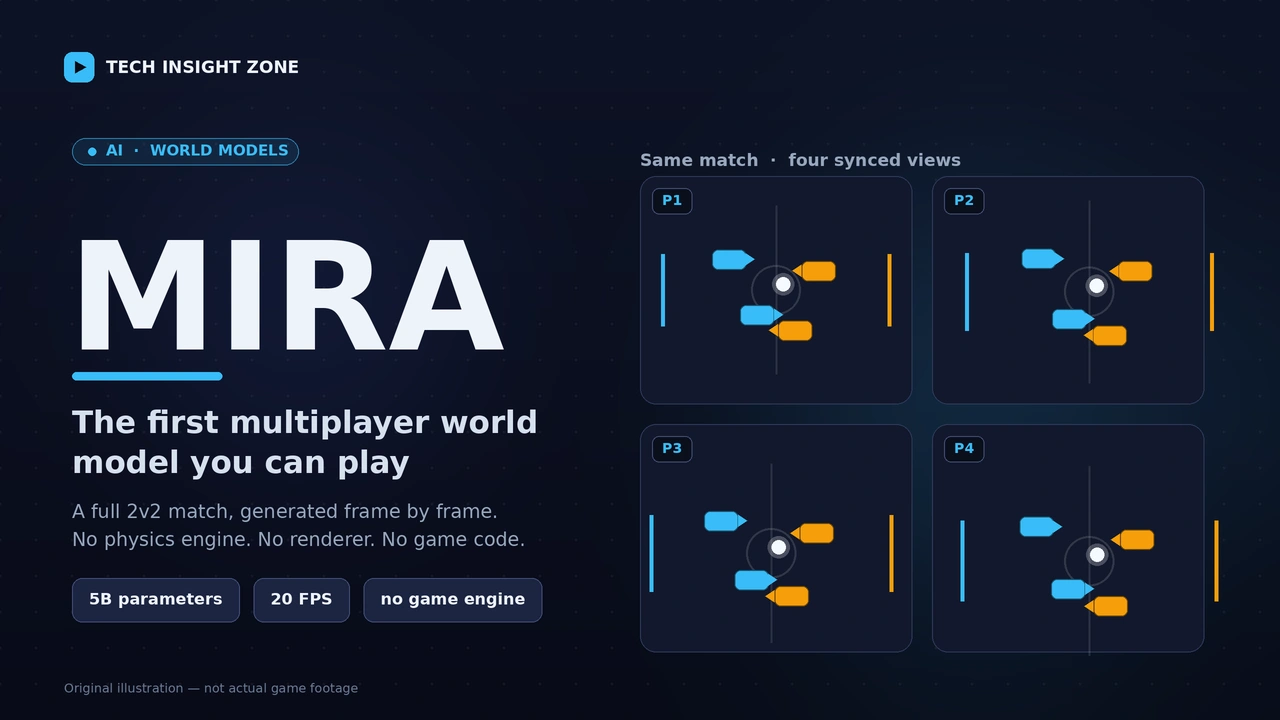
ByA team from General Intuition, Kyutai, and Epic Games has released MIRA, and the pitch is hard to believe until you watch it run. There’s no copy of Rocket League installed anywhere. No physics engine, no renderer, no game code.
A 5-billion-parameter neural network generates every frame of a 2v2 match on the fly, reacting to all four players’ inputs at once, at 20 frames per second on a single GPU. The team calls it the first interactive multiplayer world model, and the code, technical report, and dataset went public on July 5.
World models themselves aren’t new. Over the past year, Decart’s Oasis, Runway, World Labs, and Google’s Genie 3 have all shown neural networks that generate playable environments from video instead of hand-built engines. But almost all of them model one thing: a single player’s view of the world.
MIRA’s claim to a first rests on a narrower word. Multiplayer. It watches and responds to four people acting in the same space at the same time, which is a harder prediction problem than it sounds.
What “multiplayer” actually changes
Most world models treat everyone else in the scene as background motion. The other cars are just pixels that happen to move, and the model guesses where they’ll go the way it guesses where a cloud will drift.
MIRA takes the actual button presses from all four players as input instead. As AI Weekly framed it, that’s the gap between modeling a whole game and modeling one player’s slice of it.
That distinction pays off in the results. The authors report that the multiplayer model beats its single-player version, because seeing every player’s inputs removes guesswork about what happens next. Feed the model more of the truth about who’s doing what, and its picture of the shared world gets sharper.
Getting four viewpoints to agree is the tricky part. MIRA stitches the four players’ compressed frames into a single grid so its attention layers can reason across all of them at once, keeping the ball, the cars, and the score consistent no matter whose screen you’re looking at.
It also trains with “action dropout,” randomly hiding some players’ inputs so the model learns to fill in believable behavior for cars it isn’t directly told about. That’s what stops the other three players from dissolving into noise the moment their input stream goes quiet.
A game with no game inside it
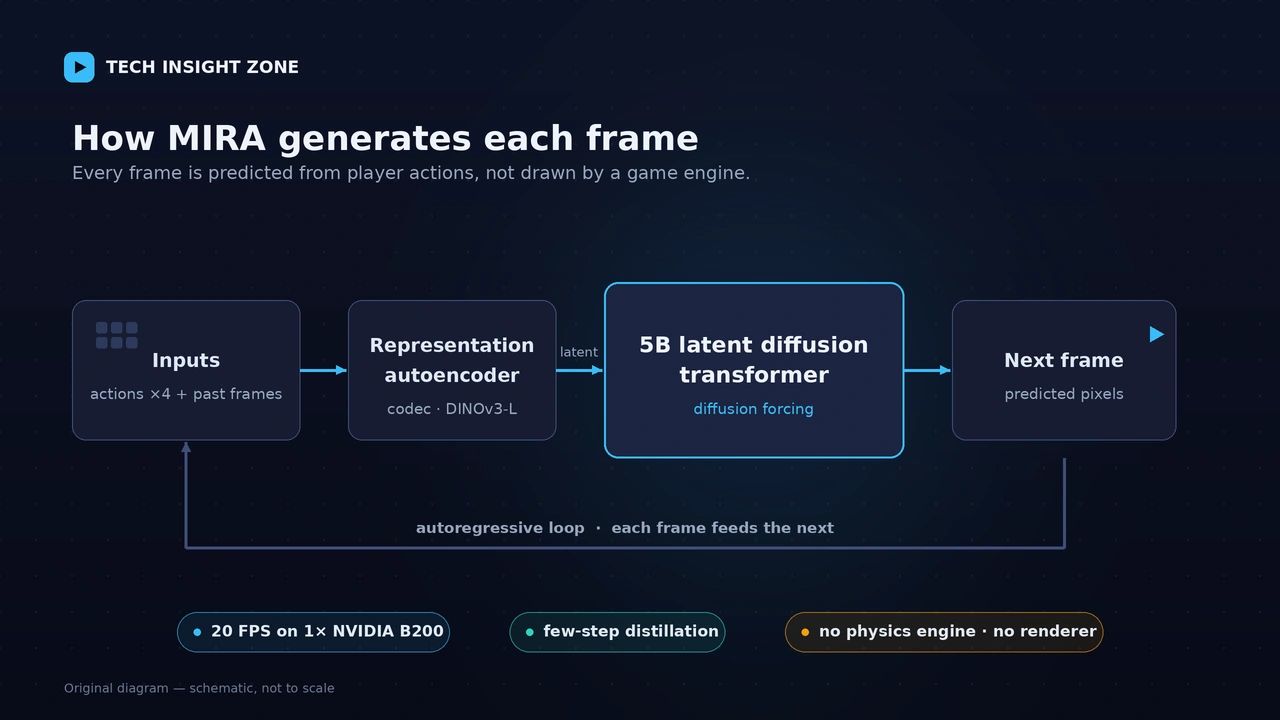
Under the hood, MIRA is a 5-billion-parameter latent diffusion model paired with a roughly 600-million-parameter video codec.
The codec squeezes each frame into a compact representation, built on top of Meta’s frozen DINOv3-L image encoder, and the diffusion model predicts the next frames from that compressed space plus the players’ actions.
No 3D geometry is stored anywhere. The model picked up Rocket League’s physics purely by watching video.
What it watched is worth pausing on. The training set was around 10,000 hours of 2v2 matches played entirely by bots, not humans. That sounds like a shortcut, and in a way it is.
Bot data is clean, cheap, and effectively endless, and it skips the mess of real human footage.
The code is fully open under Apache 2.0, and the team also released a slice of the training data as the Rocket Science dataset: 15,769 matches, about 27 TB, with synchronized video, keyboard actions, and per-frame game state for all four players.
Worth reading the fine print before you build on it, though. The dataset is gated and ships under CC BY-NC-SA 4.0, and because the footage is Rocket League, Epic’s terms apply on top: non-commercial only, with separate permission required for anything commercial. So the code is a true open release.
The data is more of a look-but-don’t-sell one.
One detail matters for anyone who actually works with these models. The team found it worked better to train the single-player model first, then warm-start the four-player one from it, rather than training on multiplayer data from scratch. Build the simple thing, then teach it to handle the crowd.
It holds up longer than you’d expect
The usual failure of generated video is drift. Run it long enough and the world melts into nonsense. MIRA’s authors say the model keeps a stable picture out to roughly five-minute horizons and, in the technical report’s words, keeps going “for hours with no sign of collapse.
” Two training choices do the heavy lifting here: diffusion forcing, which teaches the model to work from its own imperfect past frames instead of clean ones, and a few-step distillation pass that keeps it fast enough to run live.

There’s a stranger property underneath that, and it’s the one that names the model. The “RA” in MIRA stands for Representation Autoencoders, the codec that compresses each frame.
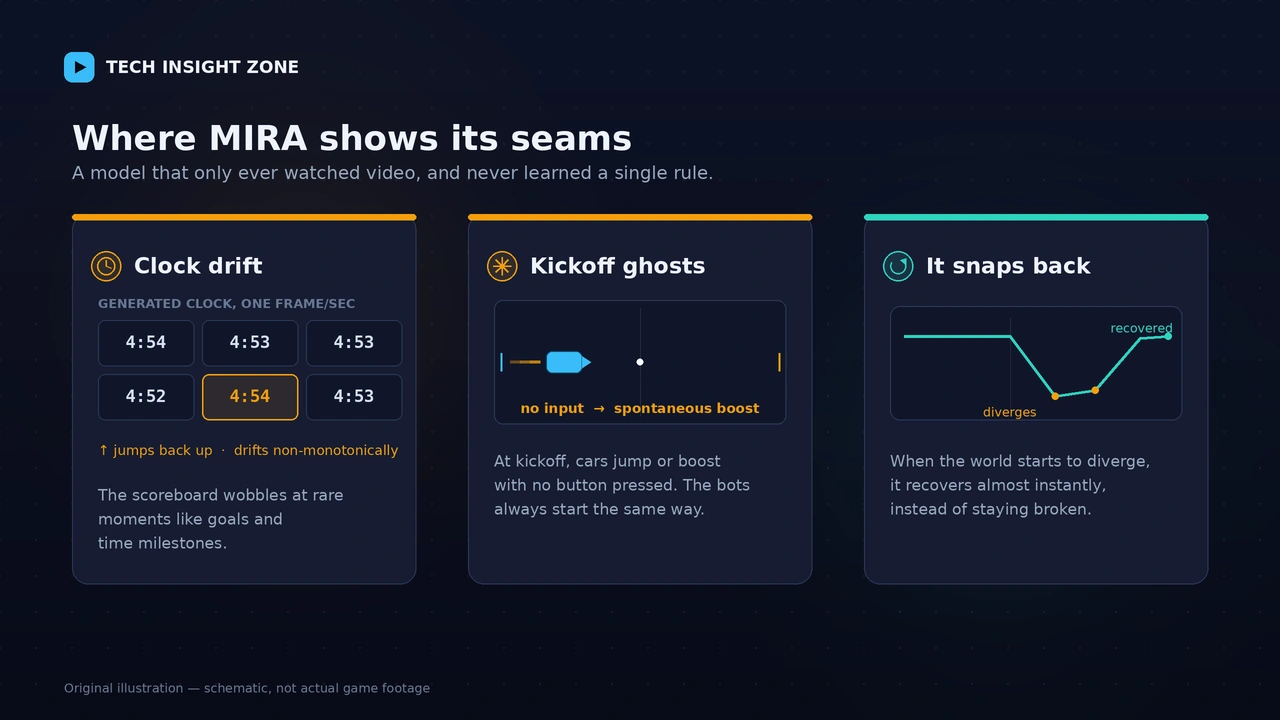
The team writes that once they moved to that codec, they noticed the model would snap back almost instantly when it did start to diverge, where their earlier codecs would drift off and stay broken. A world model that can catch itself and recover is a different kind of useful than one that just looks good for a few seconds.
It’s not flawless, and the team is upfront about where it breaks. The clock and score drift at moments that show up rarely in training, like a goal or crossing a time milestone.
At kickoff, cars sometimes jump or boost with no button pressed, because the bots almost always start the same way and the model absorbed that habit. These are the seams of a system that only ever saw video and never learned a single rule.
Why a Rocket League bot is really about robots
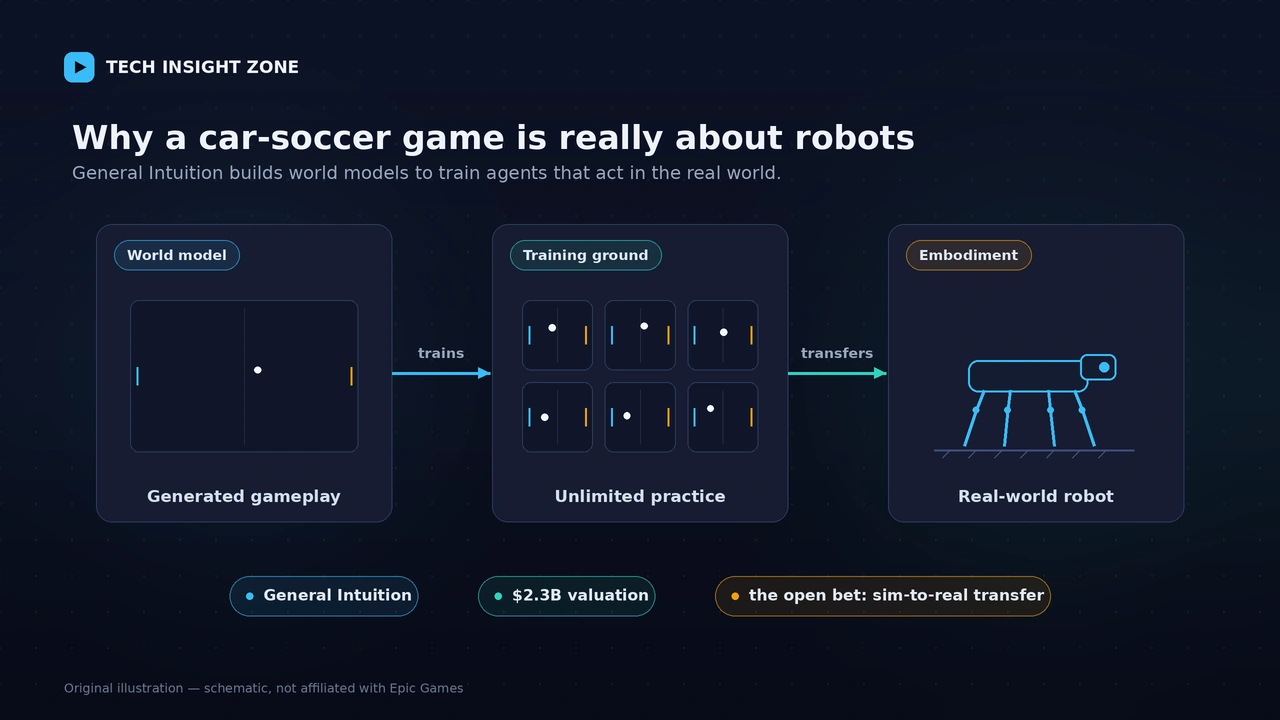
Here’s the part that explains why a startup valued at $2.3 billion spent its compute on car-soccer. General Intuition doesn’t sell world models. It builds them to train action models, the systems that decide what an agent should do next, and its actual target is agents that work in the physical world.
Rocket League is a deliberate stress test: fast, physical, full of body-on-body collisions, exactly the kind of environment a robot brain has to anticipate.

The lab closed a $320 million round in January at a $2.3 billion valuation ([which we covered at the time][link to prior coverage]), with backing from Khosla Ventures, General Catalyst, Jeff Bezos, and Eric Schmidt. Its edge is data.
General Intuition trains on billions of action-labeled gameplay clips from Medal, the clip-sharing platform its CEO Pim de Witte co-founded, where each recording captures not just what happened on screen but which buttons produced it.
There’s a neat tension in that. De Witte has said publicly that his company builds models that predict actions, not pixels, and doesn’t aim to compete with game developers. MIRA predicts pixels. The way to read it is that the pixels aren’t the product. They’re the training ground, a way to manufacture endless practice environments for the agents that are.
Michael Black, a senior author on the paper, has spent years arguing that synthetic data can train models for the real world, through earlier projects like BEDLAM and SURREAL. MIRA is that argument pointed at interactive physics.
Vinod Khosla, whose firm has led General Intuition’s funding, has compared the moment to when reasoning first emerged in language models, betting that action data from games will produce a similar jump toward something like machine intuition.
What to watch next
The honest caveat sits in the hardware. Running at 20 FPS on an Nvidia B200 is a lab result, not something you’ll play on a laptop, and a model trained on bots has learned a bot’s tendencies rather than a human’s.
The method itself, though, is already trickling down. Within days of the release, one developer trained a MIRA-style multiplayer Pong world model on a single RTX 5080 and added denoised audio, every pixel and sound coming from the same model with no game engine anywhere. That’s the part that travels.
General Intuition has said it plans to widen access to its commercial API around late summer, and the team is demoing MIRA in person at ICML. The open question, the one even Khosla admits nobody has fully answered, is whether skills learned in a simulation transfer to the real world at scale.
MIRA can dream up a convincing Rocket League match. The bet worth watching is whether the same method can dream up a factory floor a robot has never seen, and have the robot walk out the other side.


