 By
ByAnthropic filed a 31-page trademark complaint against Abnormal AI on July 1 in the Northern District of California. Six days later, Abnormal founder and CEO Evan Reiser published a blog post calling the suit surprising and disappointing.
He wrote that he found out about it from a journalist: “I learned about it from a reporter, not our ‘partner.'” Abnormal spends upward of $10 million a year with Anthropic.
Most coverage has treated this as a fight that began on July 1. I don’t think it did.
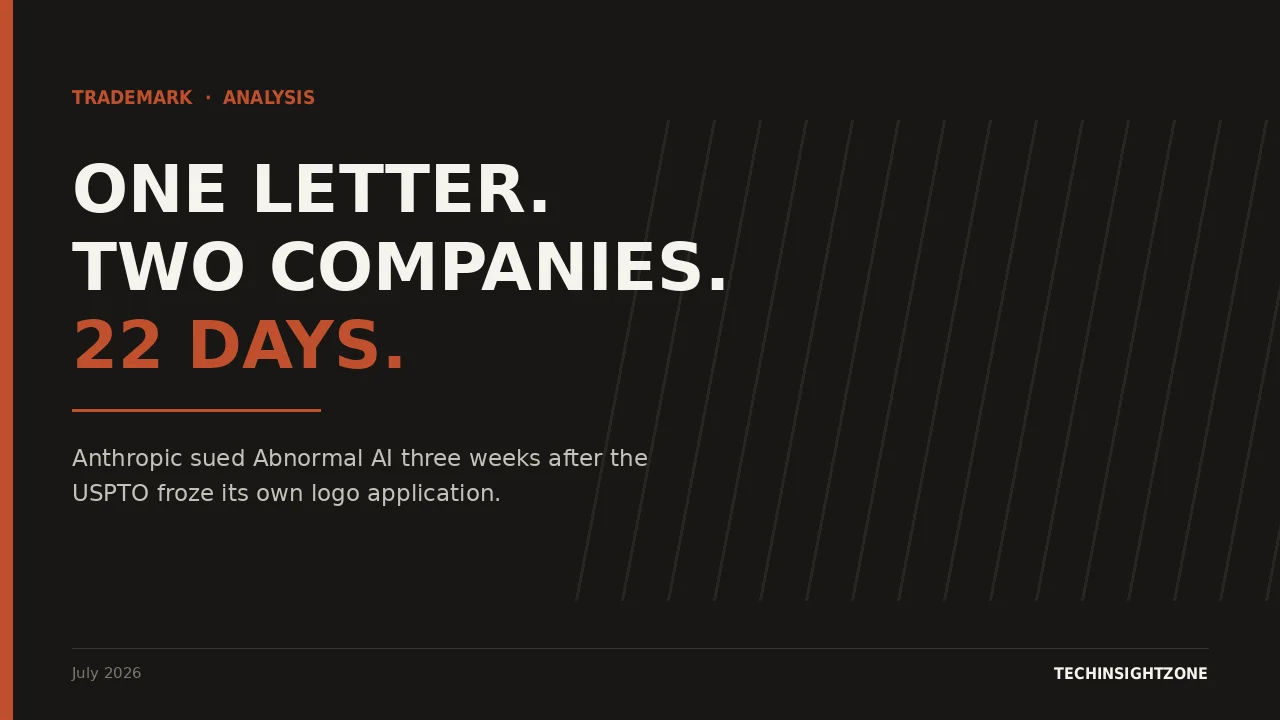
The public trademark record shows the two companies circling the same letter of the alphabet since early 2025, and three weeks before Anthropic sued, a USPTO examining attorney froze Anthropism’s own logo application because Abnormal got to the counter first.
Two companies, one letter
Abnormal is a Las Vegas company selling behavioral AI security for email, identity, and cloud apps. Reiser and his co-founder started it in 2018 under the name Abnormal AI, then switched to Abnormal Security when, by Reiser’s own account, buyers weren’t ready to take an AI-named security vendor seriously.
On April 16, 2025, the company reverted. Its legal name became Abnormal AI, Inc., its site moved to abnormal.ai, and it launched a refreshed visual identity.
Anthropic, based in San Francisco, builds Claude. The two companies are not strangers. Reiser says Abnormal has rolled Claude out to every employee and that his personal account alone will run about $1 million this year.
That entanglement is the part that made the story travel. It is not the part that explains the timing.
The priority dates are one month apart
Reiser’s defense rests on sequence. Abnormal predates Anthropic by three years. The company hired design studio ALINE in April 2021 to build its slash-based identity, months after Anthropic was founded and before Claude existed. Reiser says the wordmark on the site today is pixel-for-pixel the one ALINE delivered.
Here is what makes that less decisive than it sounds. In its opposition filing at the Trademark Trial and Appeal Board, Anthropic claims first use of its own “A” mark going back as early as May 2021, according to a review of the public USPTO and TTAB records published in June by the IP firm Harrigan IP.
April 2021 against May 2021. One month.
Trademark priority does not run on who incorporated first. It runs on who used the mark in commerce first, in the relevant market, and who filed first. On a gap that narrow, neither company gets to wave a founding date around and call it settled.
What the trademark file actually shows

That review lays out a sequence that reframes the lawsuit entirely.
Abnormal Security Corporation filed its application for a stylized “A” on March 12, 2025, roughly a month before the public rebrand. The USPTO examined it, approved it, and published it for opposition on September 23, 2025.
Anthropic filed four applications of its own for a stylized “A” beside a slanted line on November 6, 2025, covering downloadable AI software, consulting, education, and AI software-as-a-service. That’s eight months after Abnormal filing.
On November 21, 2025, Anthropic filed a Notice of Opposition against Abnormal application, opening Opposition No. 91303262 at the TTAB. It argued priority and likelihood of confusion, and that dropping the crossbar from the “A” doesn’t change the commercial impression.
Then, on June 9, 2026, an examining attorney suspended at least one of Anthropism’s four applications. The reason given was Abnormal earlier-filed application. Until Abnormal mark either registers or dies, Anthropism’s waits.
So: Abnormal filing blocks Anthropism’s registration. Anthropism’s opposition blocks Abnormal. Neither company can register its “A.” Twenty-two days after that deadlock became official, Anthropic went to federal court.
A district court judgment, or a settlement in which Abnormal abandons the mark, unsticks the queue. That is the “why now,” and it has been sitting in the public record the whole time.
The two sides are arguing about different logos
Read the complaint’s description and Reiser’s rebuttal next to each other and they aren’t describing the same object.
Law360’s Bonnie Eslinger reported that Anthropism’s suit targets Abnormal 2025 rebrand and, specifically, its animated logo transitions. Motion, not just a static glyph.
Anthropic reportedly frames the case around Abnormal reshaping itself toward Anthropism’s commercial identity while competing for the same enterprise security budgets, per GovInfoSecurity reading of the filing.
Reiser answers a narrower charge. His post defends the wordmark, and the wordmark alone, as unchanged since 2021.
Both statements can hold. When Abnormal reverted its name in April 2025, the design trade press covered it as a new logo unveiling rather than a name swap. Logo-Designer.co ran it under exactly that headline.
A wordmark can survive a rebrand intact while the identity system around it, the icon, the motion, the color, gets rebuilt. That is the comparison the case turns on, and neither party has published it.
Reiser’s post shows the 2021 wordmark. It doesn’t show the 2025 animation Anthropic is actually suing over.
What each side is claiming

Reiser’s strongest card is that Anthropic sued a major customer without a heads-up. It landed hard, and for enterprise buyers thinking about vendor risk, the perception cost is already banked.
The filings complicate it in both directions.
Anthropic served a formal Notice of Opposition on Abnormal in November 2025, so Abnormal has known for months that Anthropic contests its “A.” Gov Info Security reports that Anthropos’s complaint says it offered Abnormal time to transition off the logo and that Abnormal declined.
Anthropos’s filing reportedly treats the commercial relationship as evidence that Abnormal knew the brand well.
Cutting the other way: a TTAB opposition is a fight over whether a mark gets on a register. A federal complaint seeking disgorgement of “all revenues, earnings, profits, compensation, and benefits,” as Deal room quotes the prayer for relief, is a claim against the whole business.
One is a paper work dispute. The other asks a court to strip the proceeds of a company protecting, by Reiser’s count, more than a quarter of the Fortune 500. Being on notice about the first is not being on notice about the second.
Reiser also disputes that Anthropic owns what it says it owns. That’s half right. Trademark IA’s records show Anthropos’s ANTHROPIC word mark registered on June 9, 2026, the same day the logo application was suspended.
The word is registered. The “A” is not.
The reaction has outrun the record
Reiser’s post did what it was built to do. Within a day it was the dominant framing of the case, and the sentence about the reporter, not the trademark argument, was the thing people carried.
Then it hardened into something stronger than what he wrote. A widely shared thread from the finance account Markets & Mayhem tells readers there was no cease and desist and no conversation before the filing, only a lawsuit dropped without warning.
Reiser never claimed that. He said nobody told him about the lawsuit. Whether Anthropic ever raised the logo with him privately is a question his post does not answer, and the complaint reportedly says it did.
That silence is the interesting part. It would take Reiser one sentence to say Anthropic never contacted him about the mark. He hasn’t written it.
At least one industry outlet has been more careful than the timeline. The Cybersecurity Pulse, a newsletter read by CISOs and practitioners, covered the filing plainly and called it a strange fight to pick.
That’s roughly where informed reaction has settled: not that Anthropic has no case, but that it’s hard to see what winning buys.
It also lands during a bad stretch. Anthropic is separately defending a proposed class action filed June 14 in the same district over Claude Max usage limits.
What Anthropic isn’t saying
I went looking for Anthropos’s public response to Reiser’s post. As of this writing there isn’t one. No blog, no statement to press, no reply from the company account. The suit speaks and the plaintiff doesn’t.
Silence is a defensible litigation posture. It is a costly communications one, particularly for a company that sells trust to CISOs.
Gov Info Security notes that Abnormal doesn’t appear among the roughly 200 vendors in Anthropos’s Project Glassing, nor among the security tools integrated through the Claude Compliance API, a list that includes Binormal’s email-security rivals Proofpoint and Mimecast.
Big customer, thin technical ties. That asymmetry may be the whole reason this became a lawsuit rather than a phone call.
What to watch
Three things. Whether Abnormal moves to dismiss or answers on the merits, which will tell you if it wants a fast exit or a public fight.
Whether either side asks the court or the TTAB to pause proceedings, since parallel tracks on the same marks are wasteful and someone usually blinks. And whether Anthropic breaks its silence, because Reiser has spent a week defining this story unopposed.
The four frozen applications are the tell. Watch the docket, not the blog posts.


