 By
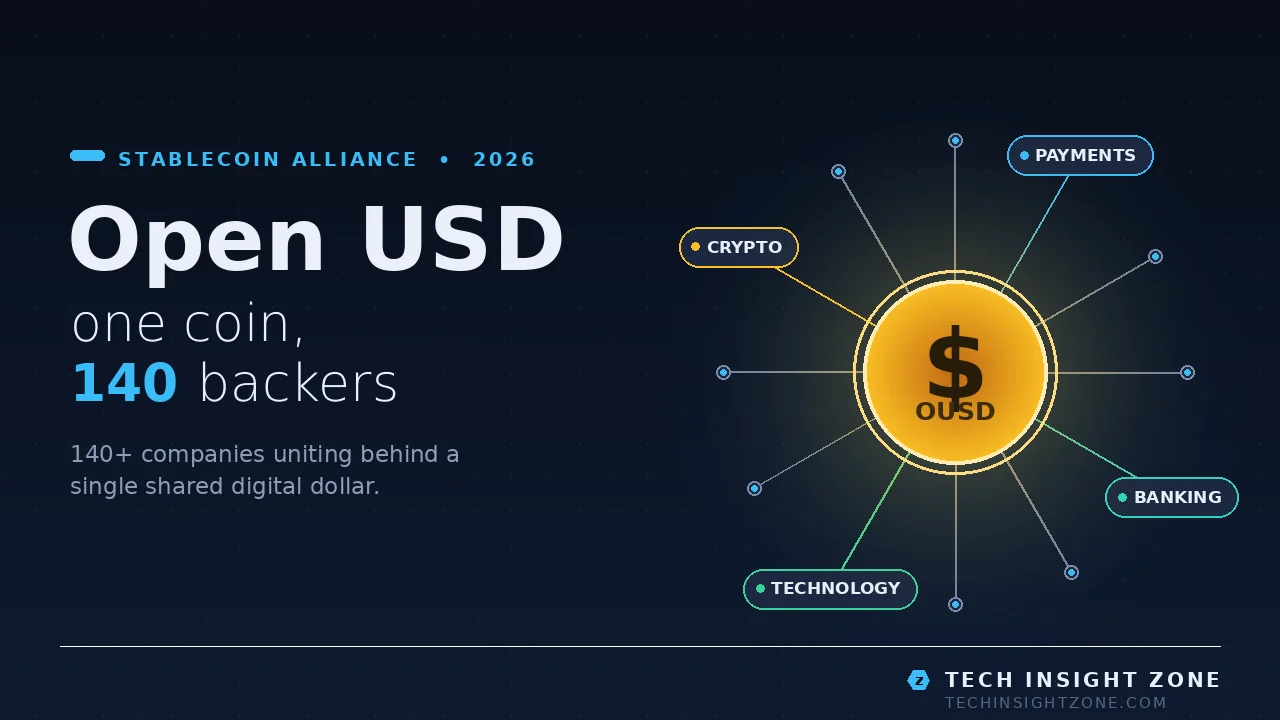
ByOn June 30, more than 140 companies did something they almost never do. They agreed to back the same dollar.
Visa and Mastercard, which fight over every swipe, signed up alongside American Express. BlackRock, Stripe, Coinbase, Google, BNY and Shopify joined too.
The vehicle is Open USD, or OUSD, a dollar-pegged stablecoin run by an independent company called Open Standard. The coin itself won’t go live until later this year. That’s the strange part. The launch that moved markets was really just a guest list.
Why a guest list rattled anyone
To see why, you have to look at how stablecoins make money. A stablecoin is backed by reserves, usually short-term US Treasuries and cash, and those reserves earn interest. Under the current model, almost all of that interest goes to the issuer. Reserve income made up the majority of Circle’s revenue last year, and it’s the same story for Tether.
The GENIUS Act, signed into US law in July 2025, gave payment stablecoins a clear legal footing and opened the door to a wave of new entrants. The market is now worth more than $300 billion.
Tether’s USDT held roughly 62% of it in April and Circle’s USDC about 25%, per CoinDesk data cited by TNW. Whoever controls the biggest coin controls a very large, very sticky pile of cash that throws off income every day it exists. That pile is the prize everyone is circling.
What actually makes Open USD different

OUSD doesn’t try to reinvent how a stablecoin holds its peg. The change is in the business model. Open Standard says businesses will be able to mint and redeem OUSD with no fees and no volume caps.
The bigger break is on the reserves. Nearly all of the interest earned on the assets backing OUSD is set to flow back to the partners who distribute it, after a small management fee that covers operating costs.
That inverts the usual arrangement. Normally, a payment company that integrates a stablecoin helps grow the issuer’s balance sheet while keeping little of the reserve income for itself. Open Standard’s pitch is that the companies driving usage should share in the yield their own customers’ balances generate.
The idea underneath it is a quiet but real shift: separating the value of the money from the ownership of the money. The dollar stays a dollar. The economics of holding it get spread across a network instead of pooling with one issuer.
Governance follows the same logic. OUSD is run by a board drawn from partner firms rather than a single company. Zach Abrams, co-founder of Bridge (the stablecoin firm Stripe bought in 2024), is Open Standard’s founding CEO.
He argues businesses need a stablecoin that is open, low-cost and high-throughput, built around their interests rather than someone else’s roadmap. This isn’t the first coin to try sharing reserve economics with its partners, but it’s by far the largest attempt.
Why every layer of finance wanted a seat

The partner list is the actual story, and each name is there for a specific reason.
Start with BlackRock. A stablecoin’s reserves sit in short-term Treasuries and money-market instruments, which is exactly what BlackRock manages.
A dollar coin at scale would hold tens of billions in cash that needs a manager, and that manager collects fees on the most predictable balance in the system. Joining as a partner, rather than competing for the mandate from outside, tells you BlackRock expects OUSD to get big.
Shopify is there for the checkout. Merchants pay interchange on card payments and sit on working balances that earn them nothing. A coin that settles instantly, costs less to accept, and pays yield on those idle balances answers both problems at once. For a platform with millions of merchants, that goes straight to margin.
The banks are the most telling guests, because they have the most to lose. BNY, Standard Chartered, DBS and U.S. Bank all earn from holding deposits and moving money across borders, both of which stablecoins chip away at.
Their move is defensive. Better to sit inside the coalition, keep the custody and settlement work, and share the reserve income, than to watch balances walk out the door for a coin they have no stake in.
Even the card networks are hedging. Mastercard recently bought stablecoin firm BVNK for as much as $1.8 billion, a sign of how far the networks will go to own a piece of tokenized settlement.
Markets read it as a shot at Circle

Investors treated the announcement as a direct hit on the incumbent. Circle’s stock fell more than 17% on June 30, closing below $63, its weakest level since late February and down 55% from its mid-May high, according to Disruption Banking.
CEO Jeremy Allaire pushed back, saying Circle welcomes “continued innovation and competition in the space.”
Part of the sting was who showed up. Coinbase earns roughly half of the reserve income on USDC under its distribution deal with Circle, a stream Bernstein pegs at close to 20% of Coinbase’s total revenue.
Watching that same partner help launch a rival, with the Circle agreement due for renewal around August, is what reset the thesis for a lot of investors. Allaire said the Coinbase relationship remains as strong as ever.
Tether was more relaxed about it. CEO Paolo Ardoino greeted the launch on X with “Welcome OUSD. Player 2 has entered the game.”
The distribution promises are what gave the launch teeth. Stripe said it will make OUSD the default stablecoin for businesses on its platform. Coinbase confirmed the token is coming to its Base chain and others later this year. Executives from BlackRock and Mastercard framed the effort around business choice and interoperability rather than an attack on any one rival.
OUSD is set to launch natively on Solana first, with Base, Stellar, Polygon and Aptos among the chains set to follow later in 2026.
The skeptics, and the roster problem
Not everyone bought the panic. Analysts at William Blair called the competition fears overblown and compared OUSD to payment consortiums that flopped before, like MCX and Paze. The old knock on group efforts holds: too many owners at the table slow everything down.
ARK Invest research director Lorenzo Valente raised three specific doubts, a cold-start liquidity problem, no established trading pairs against major crypto assets, and governance friction from a crowded roster of stakeholders.
Bernstein made the same case with numbers. It kept its Outperform rating on Circle and a $190 price target, more than 200% above where the stock landed after the drop, arguing that the coalition proves stablecoins matter as a category without immediately denting USDC.
There’s also history to lean on. USDG, the consortium-backed coin from Paxos, launched in 2024 on much the same yield-sharing promise and has grown to only about $3 billion. The bigger ghost is Libra, the Facebook-led coin that assembled its own all-star roster in 2019 and collapsed under regulatory pressure before it ever shipped.
Then there’s the roster itself. A July 3 Chosun Biz report found several Korean firms named around the alliance, including Samsung Electronics, Shinhan Financial Group, Dunamu and Kbank, that had not formally committed or even held talks.
Open Standard’s own site listed a long “backed by” section while some of those companies described themselves as undecided. When a coalition sells partner count as its main trust signal, the gap between “committed” and “considering” starts to matter a lot.
Regulators may weigh in too. Banks outside the consortium, including JPMorgan, have pushed for tighter oversight, arguing that paying yield on wallet balances lets crypto firms compete with bank deposits without the same capital rules.
What to watch
None of this is live yet. OUSD is a promise with a very long list of names attached, and the token doesn’t ship until later in 2026. The number that will actually matter isn’t 140 partners.
It’s how much volume those partners route through OUSD once it exists.
Watch which chains go first, whether Stripe and Coinbase move real transactions onto it, and how Circle answers on pricing. Partner count opened the door. Adoption is the only thing that decides whether the coalition becomes infrastructure or just a very impressive launch photo.


