
 By
BySwift Package Index, the site most Swift developers open when they need to vet a dependency, said on June 23 that it has joined Apple. The announcement came as a short post on the project’s own blog, written by the same team that has run the index since 2020.
No money figure was attached, and the post used a single word for the deal: “joined.” Package authors and the developers who rely on the site won’t see anything change today. The longer story is about where Apple wants to take Swift’s package tooling next.
This isn’t Apple’s first involvement with the project. Back in March 2023, Apple became a financial sponsor, joining backers like MacStadium and Microsoft Azure that helped cover the site’s running costs. That was money and an endorsement.
This is something else. The team and the site itself are now inside Apple, which moves the index from “community project Apple helps pay for” to “Apple-run project the community still contributes to.”
For a tool that sits between developers and nearly every third-party dependency they ship, that shift in who holds the keys is the whole story.
From an index to a registry
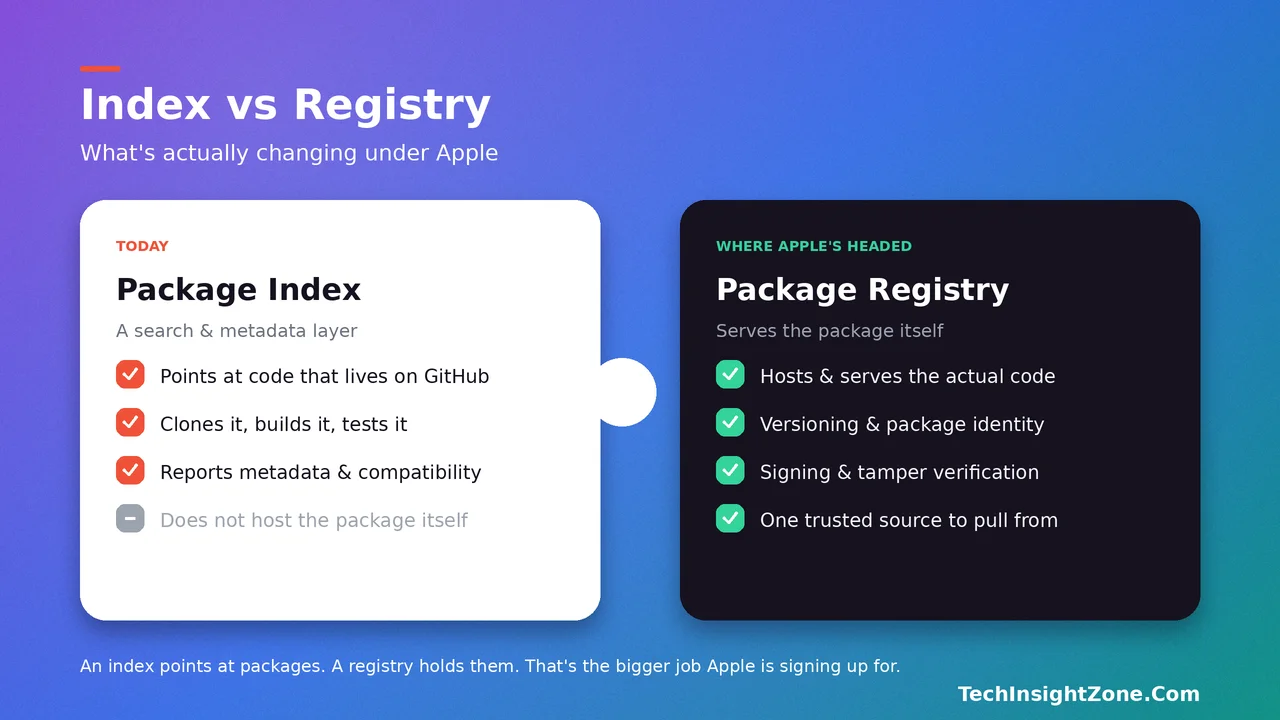
The most telling line in the announcement is about scope. The team wrote that together with Apple, they’re building a “comprehensive package registry” for Swift. That phrasing matters, because an index and a registry aren’t the same thing.
Today, Swift Package Index is a search and metadata layer. It points at packages that live on GitHub, clones them, builds them, and reports back what it found. It doesn’t host the actual code.
A registry does. A registry serves the package itself, with versioning, identity, and a guarantee that the thing you downloaded is the thing the author published.
Swift has had a registry specification in the works for years through the Swift Package Manager, but real-world adoption stayed thin.
Folding the most-used discovery site into Apple, and pointing it at registry work, suggests Apple wants to close that gap using a service developers already trust rather than launching a new one from zero.
What stays the same, for now
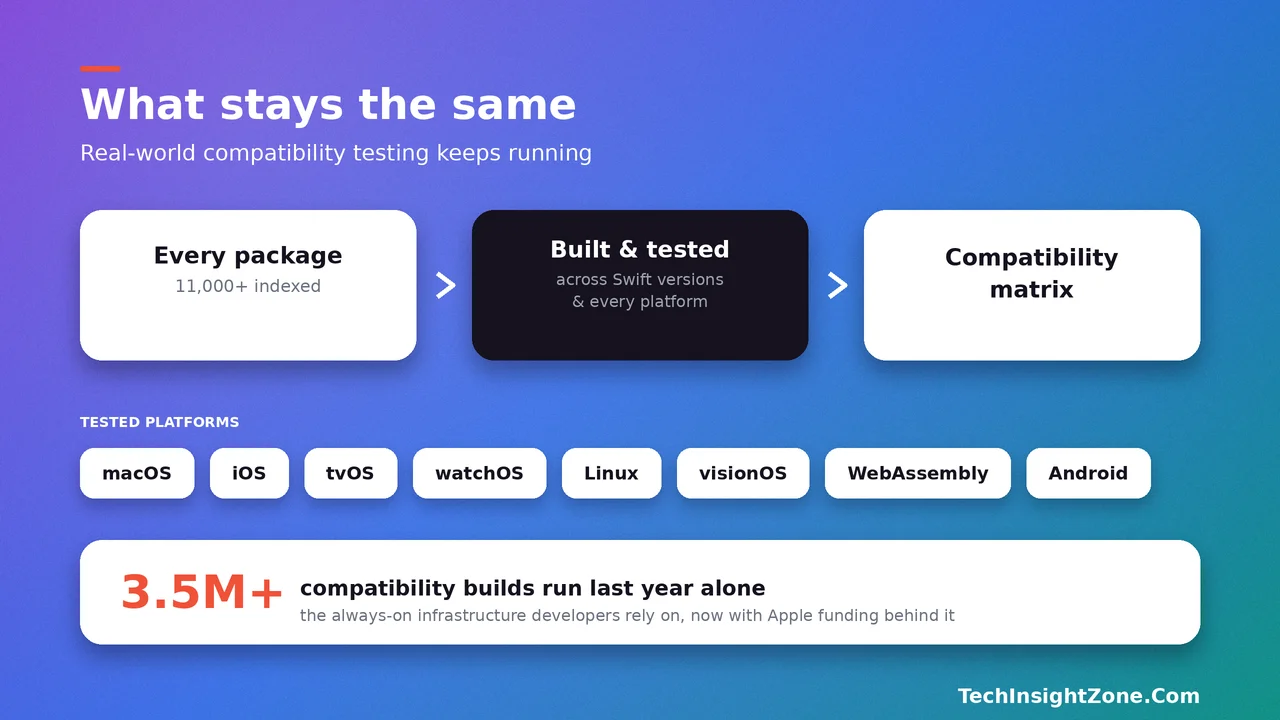
The team was specific about what isn’t changing. Packages get indexed the same way. Documentation stays hosted where it is. The compatibility testing keeps running.
That testing is the part many developers don’t think about but lean on constantly. The site builds every package against multiple Swift versions and platforms, from macOS and iOS through Linux, visionOS, WebAssembly, and Android.
The team says it ran more than 3.5 million of those builds last year alone. That’s the kind of always-on infrastructure that’s genuinely hard for a small team to keep funded, which is part of why the Apple backing reads as a stabilizer rather than a threat to most developers.
The security angle nobody’s talking about enough
The post also flagged where new work is headed: package signing and identity. In plain terms, that’s about proving a package came from who it claims to, and that nobody tampered with it between the author and you.
Supply-chain attacks through poisoned dependencies have hit other language communities hard, npm especially. Swift has mostly avoided that so far, partly because the package world is smaller.
Apple putting its name and resources behind signing is the sort of slow, unglamorous infrastructure work a volunteer project struggles to prioritize, and it may end up being the most consequential part of this whole move.
What the coverage and the community are saying
Early coverage zeroed in on one likely outcome: tighter Xcode integration. 9to5Mac noted that Apple could eventually let developers search for and add packages directly inside Xcode, instead of the current flow where you paste a repository URL and hope you grabbed the right one.
That would turn the index from a website you visit into a feature built into the tool developers already work in all day.
The reaction elsewhere was more mixed. On Hacker News, plenty of developers welcomed the stability of a critical piece of community infrastructure finally having real funding behind it. Others reached for history.
One comment invoked Sherlock and Watson, Apple’s old habit of folding a popular third-party app’s idea into the OS and leaving the original behind.
The fear here isn’t that Apple shuts the index down. It’s that an independent, neutral arbiter of package quality gets a lot less neutral once the platform vendor owns it.
The questions the announcement didn’t answer
The post leaned on “open source” for the code, and that pledge is real. But open source covers the software, not the governance. Who decides which packages get flagged, ranked, or featured?
If the index starts surfacing Apple’s own packages or Apple-blessed alternatives more prominently, that’s a policy choice, not a code change, and publishing the repo wouldn’t reveal it.
There’s a neutrality question for non-Apple platforms too. A real share of Swift’s growth is on the server and on Linux, often nowhere near Apple hardware. The index has treated those platforms well.
Whether an Apple-run version keeps Linux and Android as first-class targets, rather than afterthoughts, is something the server-side Swift crowd will watch closely.
What to watch next
The team says it’ll share specific plans over the coming months, so the real signal will be in what ships, not in the announcement copy.
Three things worth tracking: whether package search shows up natively in a future Xcode release, whether the long-promised Swift package registry finally lands in usable form with signing attached, and whether the original team stays hands-on, since their judgment is a big part of why developers trusted the site to begin with.
For now, nothing breaks and nothing moves. The index works exactly as it did last week. The interesting part starts when Apple shows what it actually wants to build.
Primary source: Swift Package Index blog.


